
It was the summer of 1971, I was 14 years old, and I was on the verge of a rite of passage every young boy undergoes. That summer, I would start my first real job, you know, the kind where you get paid less than you actually earn.
Neighborhood Youth Corps was a program established in 1964 as part of President Lyndon B. Johnson’s War on Poverty, providing job training and employment opportunities to economically disadvantaged youth. An emphasis was placed on civic and community service. The Neighborhood Youth Corps program was a developmental and financial success for many of us.
I can remember it as if it were yesterday. We all dutifully showed up for the first two weeks, excited and anticipating our first paychecks. We would be paid $50 per week for 6 to 7 weeks. After taxes, we received approximately $45. Many of us discussed what we would do with our first paychecks. Some of us helped with our family’s finances, while others were dreaming about the next pair of Jordache jeans or a pair of Playboys (shoes). My Mother and Father placed the onus on us. They believed that since you worked for it, you earned the right to make decisions about it, as long as it wasn’t used for anything illicit.
The day we received our first paychecks, we had to hop on the # 6 train down to the financial district to cash our checks because East Harlem was a banking desert. Growing up in Harlem was like growing up in a city within a city. Heading downtown was always an opportunity to explore. We were a bunch of young teens who “had their minds on their money and their money on their minds.” My coworkers decided to head down to Delancey Street, an old-school market district where you could negotiate prices on all kinds of goods, from electronics to clothing. I opted to check out things in the financial district.
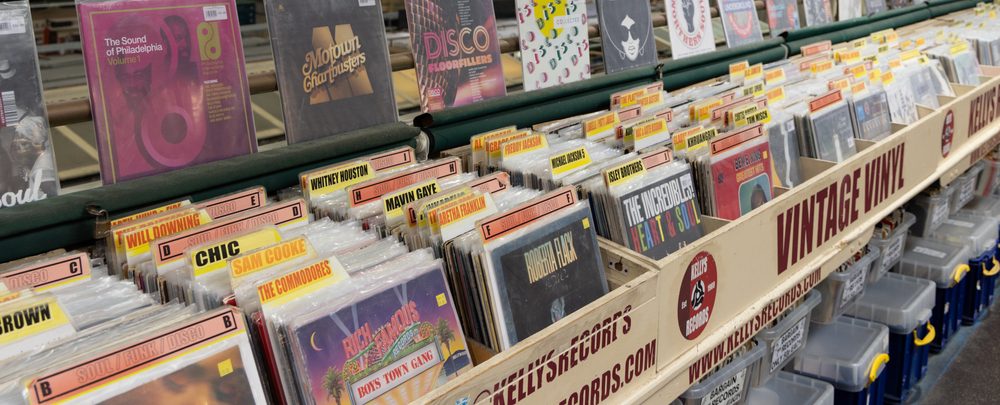
I wound up on Park Row and saw a storefront that said it sold music albums for $1.99, $2.99, and $3.99. The store was named J&R Music. I didn’t know it at the time, but they would become one of the largest music and electronic retailers in the country. It couldn’t have been more than 500 square feet, but it practically filled every inch of that space with album bins. It was amazing how I stumbled upon this treasure trove of beats, harmonies, and rhythms.
I spent the next two hours rummaging through record bins, toting an armful of albums, and swapping them out. I tried to display some discipline by limiting myself to spending half of my check on records. I walked out that day with six albums that included What’s Going On by Marvin Gaye (still my favorite album of all time), The Woodstock Album, Curtis by Curtis Mayfield, Sticky Fingers by the Stones, and Shaft by Isaac Hayes. As I made my way back uptown, at every stop my anticipation grew. As excited as I was about arriving home, I couldn’t resist stopping to show off my bounty to friends and telling them about J&R.
Once I was in the sanctity of my bedroom, which at one time housed three Watlington boys, I performed a ritual that would become a weekly routine for the next six weeks. Each album had cellophane to remove, and rather than ripping it off, I made a surgical incision in each. Each album would be covered by a liner, and depending on the album, it could be a nondescript white paper or an elaborate photo-and-fact-filled presentation that tells the story behind the music. At that time, I still had my first basic stereo component and hadn’t yet graduated to the gold Marantz stereo system I would own two years later.
The stage was set, and the first album I opened was What’s Going On. After inspecting the album for blemishes, it was time to get into the music. One of the things that made this album so special was not only its prescience at the time but also its relevance pertaining to major issues and challenges confronting us today.
While the music played, I focused on reading the album cover and liner notes. I loved learning who the musicians, songwriters, and collaborators were. Artists also put a great deal of energy into album artwork and presentation, eye candy. As I lay back on my trundle bed and listened to Marvin soulfully wail and preach about war, poverty, drug addiction, and environmentalism, I was transported to a place that few art forms can take you. I was frozen in place, and the only thing that could disturb this state of bliss was a song that began to “stick.” More often than not, that led to listening to an album uninterrupted from beginning to end.
By the end of the summer, I had purchased approximately 42 albums and had an opportunity to interact with the young couple, Joseph and Rachelle Friedman, the J&R of J&R, several times. Their story is incredible. They were 20-year-olds who started the business to support their pursuit of other careers. Their initial small business (500 square feet) grew to occupy an entire block on Park Row in the mid-1990s. By the end of the summer, my album collection had grown. I added albums from artists like Earth, Wind & Fire, Aretha, Diana Ross, Traffic, Santana, and Carole King. All of my summer purchases would accompany me back to school in Connecticut.
I would work in the Neighborhood Youth Corps program for two more summers, and I continued to trek down to 23 Park Row to spend approximately half of my paycheck on music. My ritual would stay the same with one pretty significant change. I aged into a music-enhancing practice that really made the music jump out of the speakers, downright symphonic. By the time I moved out of my parents’ house, I had acquired several hundred albums that I left behind, but that wasn’t the day the music died. My older brother reminds me regularly how important the music I left behind was to his recovery from drug addiction.
Flash forward to today, and I am the proud owner of 5,579 albums, 2,520 artists, and 29,001 songs, all digital. I have DJ software that lets me replace my imperfect cassette mixtapes with near-professional-quality mixes. Technology has made it possible to transport my music effortlessly across countries and given me access to hundreds of thousands of songs.
That said, there will never be anything like the feeling of engagement and connection with the music and artists that went into the music experience back then. Every weekend in the summer of 1971 was a music appreciation session, and I wouldn’t trade that for all of the technological advances in the world.
Views: 432